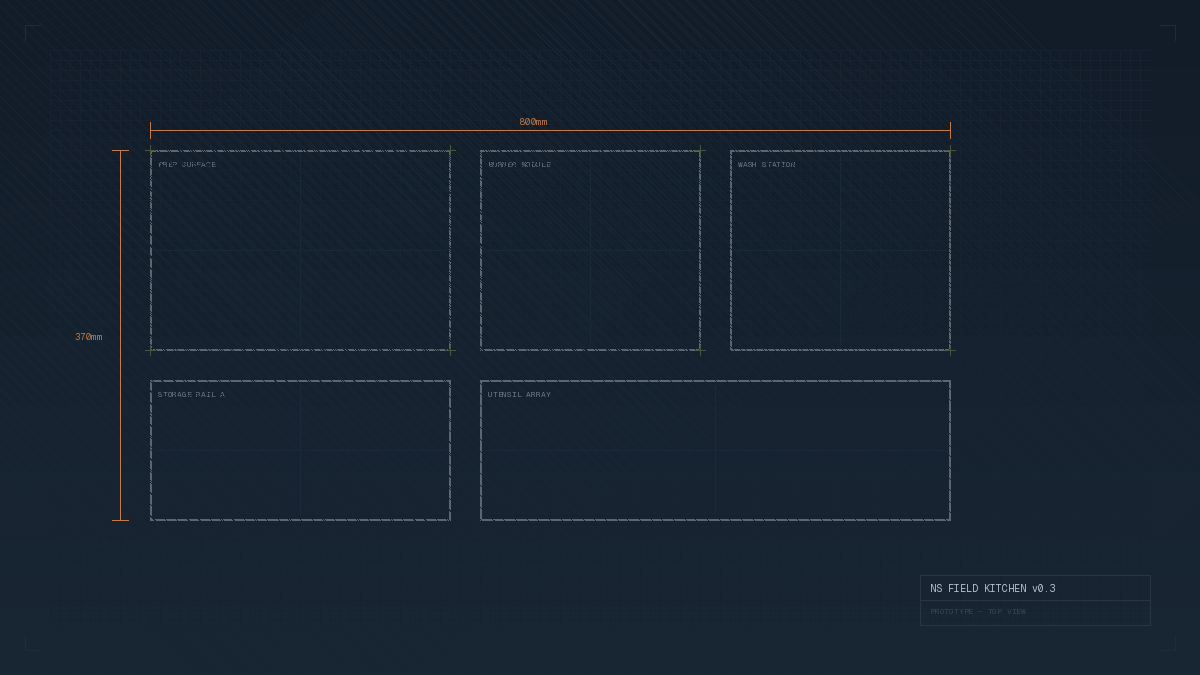
We drove to 9,200 feet with the Field Kitchen prototype mounted on a rough-terrain cart, packed into a truck that probably wasn't the ideal delivery vehicle, and set it up on a granite outcropping as the sun broke through the treeline. The ambient temperature was 28 degrees Fahrenheit. What followed was the first unscripted field test of the NS-K01—two meals, four hours of continuous use, one failed mechanical component, and enough real data to shift the direction of the entire next production cycle.
The prototype arrived at our workshop in Denver eight weeks before this field deployment. The design had been refined over six months—iterations of the cooking surface layout, the structural frame geometry, the mechanical locking system. In the shop, we tested the fold-down mechanism fifty times. We stress-tested the aluminum seams. We verified the weight distribution and confirmed that one person could move it unassisted. But the shop is a controlled environment. The high desert in late winter is not.
The setup process revealed the first friction point. The NS-K01 is designed to fold down to 48 inches wide for transport and then expand to full working depth. On paper, the deployment sequence was intuitive—release the four corner locks, swing out the support frame, secure the T-bolt rail at each end. In practice, at altitude with cold hands, the sequence required more force than the design had anticipated. The corner locks, elegant in their simplicity, had a handle radius that didn't give adequate mechanical advantage. Barron commented, "You need about six inches more lever distance," and he was right. We made a note.
Once deployed, the 48-inch working surface revealed itself. The 5052-H32 aluminum took a five-quart pot without any flex or deflection. This was the core design requirement—cold-forged, work-hardened aluminum can provide a cooking surface that behaves like a traditional stove top. The first test was pancakes. We heated water for forty minutes and never saw a ripple in the cooking surface, even under the weight of cast iron.
The material science worked exactly as intended
The waxed canvas cover—we'd chosen 10oz waxed duck cloth instead of conventional nylon, which tends to hold moisture and freeze in field conditions—shed snow and rain without absorbing water. The cover's weight created useful compression on the folded aluminum, which meant the whole assembly, when in transport configuration, had structural rigidity even before the locking mechanism engaged.
The failure, when it came, was instructive. By the second meal—we'd made breakfast at 8 AM and dinner at 4 PM—one of the corner locking clamps was showing a hairline crack in the cast aluminum bracket where it connected to the main frame. The clamp itself was still functional, but the stress concentration at that joint was real. We've known for months that this joint needs reinforcement. The prototype confirmed it in exactly the way we needed: not through calculation, but through use.
The crack didn't stop us from cooking. The east corner took enough load to keep the structure sound. But it was the clearest signal that the prototype-to-production transition needs to move the entire corner assembly to a welded steel design. Aluminum is right for the work surface and the fold-frame. Steel is right for the load-bearing joints. We're changing that for prototype two.
What the 48-inch width actually enabled
The other observation came from Barron's actual workflow—he's a backcountry cook, experienced with everything from car camping to alpine expeditions. He noted that the 48-inch width meant he could set up three cooking operations simultaneously: the primary burner with the cast iron skillet occupying the center zone, prep space on the left, plating area on the right. With conventional camp stoves, you're restricted to one operation at a time. The field kitchen changes that equation. The aluminum surface area makes it actually possible to run parallel cooking tasks.
"Cooking on this thing is different. The aluminum surface conducts heat so consistently that you don't get the hot spots you have with traditional camp stoves. The pancakes cooked evenly. What surprised me was how much control you get from the T-bolt rail system—if you need to shift a pot six inches in any direction, you loosen one bolt and slide it. We made breakfast for two on this at nearly 10,000 feet in subzero conditions, and I never once felt like I was fighting the equipment. The cover folded down and didn't interfere. The only moment where I thought 'this isn't working' was when I needed to tighten the main frame clamp on the east side. The handle isn't long enough."
We broke down the prototype at 6 PM as the light faded and the temperature dropped to 22 degrees. The fold-down sequence—the reverse of the deployment process—took slightly more time than we'd allocated because we were deliberately careful, trying to see where else friction points might appear. None did. The system folds intuitively once you understand the sequence. The cover wraps cleanly. The whole assembly secured to the cart in three minutes flat.
The path from prototype two to production
For prototype two, the changes are clear: the corner joint reinforcement moving to welded steel, the corner lock handle lengthened by six inches, a small modification to the T-bolt rail end caps to reduce the chance of snagging the canvas, and a minor adjustment to the canvas attachment points to reduce compression of the aluminum edges. These aren't fundamental redesigns. They're field-informed refinements. This is what the prototype-to-production process is supposed to be: listening to what the equipment tells you in real conditions, then building that feedback into the next iteration.
Walking back down the mountain with the field kitchen secured in the truck, I thought about the difference between designing something in CAD and testing it under actual use. The software told us the structure would hold. The field test confirmed it, then showed us the edges where the design needed sophistication. That's not a failure of the prototype. That's the prototype working exactly as it should.