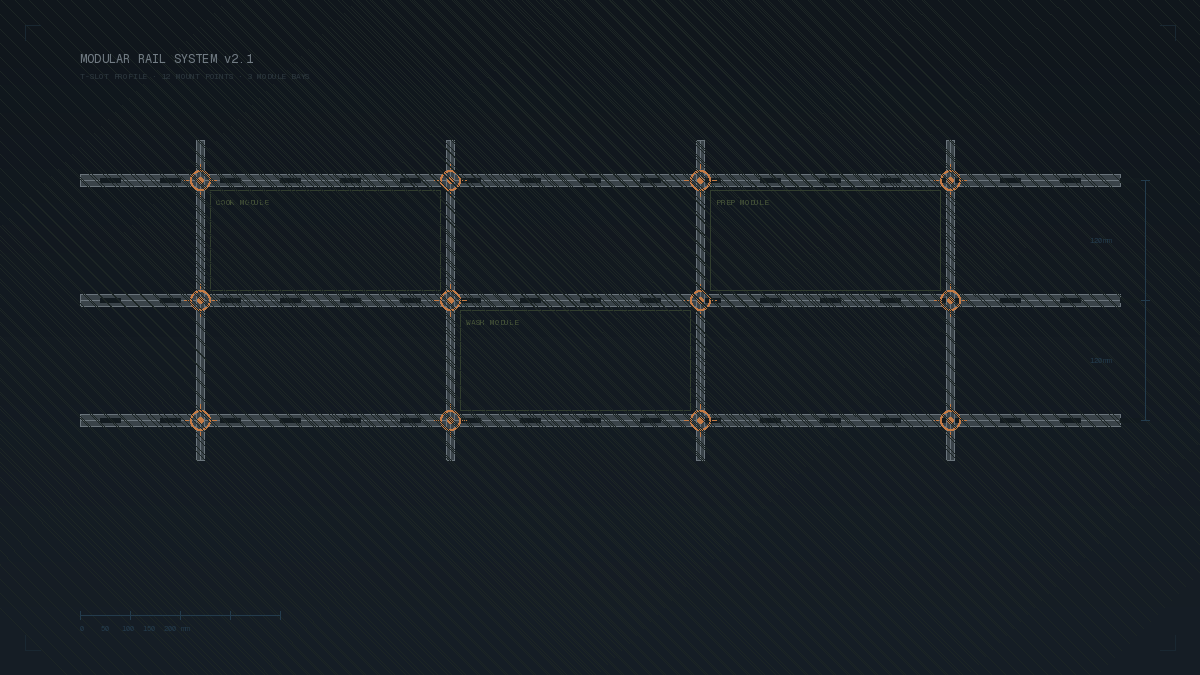
The NS-T01 Field Table's most important feature isn't something you see at first glance. It's the aluminum T-bolt rail that runs around the perimeter of the working surface. It's industry-standard, 304 stainless steel, 1.5-inch profile. That's the decision that unlocks everything—accessories, modularity, a camp kitchen that grows with your needs instead of being locked into whatever configuration ships from the factory.
Most camp equipment uses proprietary mounting systems. You buy the table, and it's locked into a specific configuration. Want to add a shelf? You need that brand's shelf, designed by that brand's engineers, manufactured in that brand's factories, sold at that brand's margin. It's vertical integration masquerading as completeness. We wanted the opposite: a table that accepts industry-standard components because we believe you should be able to build your own ecosystem.
The modularity logic
A T-bolt rail (also called a T-slot rail) is used in industrial manufacturing, laboratory equipment, and professional workbenches. There are thousands of third-party accessories designed to work with it. Mounting brackets, shelves, clamps, tool holders. If you have a 1.5-inch T-slot rail, you can attach any T-bolt component designed for that profile. No proprietary tooling. No manufacturer lock-in. Just mechanical compatibility.
When we were designing the NS-T01, the temptation was to create a custom system—something that looked sleek, was engineered precisely for our accessories, and locked users into our ecosystem. Barron pushed back. He said, "If someone wants to mount a third-party stove or a custom shelf they designed themselves, they should be able to do that without asking our permission." That observation shaped everything.
We chose the T-bolt standard not because it's the cheapest or the easiest to manufacture. We chose it because it's open. There's no patent. There's no licensing. There's just mechanical logic: a rail with recessed T-shaped slots, bolts that slide into those slots, and the ability to attach almost anything you can design.
Weight distribution and structural logic
The NS-T01 is 48 inches wide and 24 inches deep. The working surface needs to handle distributed loads—multiple pots, utensils, cooking equipment—without deflection. The T-bolt rail around the perimeter isn't just for mounting accessories. It's structural. The rail is welded to the aluminum frame at load-bearing points. The T-slot profile provides deep mechanical engagement. This isn't a cosmetic choice; it's a load distribution system.
When you clamp something to a T-bolt rail, you're not relying on friction or surface adhesion. You're engaging mechanical geometry. The bolt slides into the T-slot, and when you tighten it, you're creating a rigid connection that can handle side-loading and stress. That's why industrial equipment uses this standard—it's load-efficient and reliable.
The frame geometry was designed with the rail mounting in mind. We ran finite element analysis on the table structure with various accessory loads distributed across the rail. The stress patterns showed that a perimeter rail with strategic reinforcement points distributed loads more evenly than a traditional frame. It meant we could use lighter aluminum without sacrificing rigidity. The rail became structural, not decorative.
The four launch accessories and sequencing
For the NS-T01 launch, we're introducing four accessories designed to use the T-bolt rail system. Each one is sequenced to address a specific pain point in camp cooking.
The Spice Rack Mount is the first. It's a simple bracket system that holds six small containers at working height, accessible from any angle. You can mount it on any side of the rail. The bracket mounts with two T-bolts and moves along the rail freely. You can reposition it depending on your dominant hand and the cooking configuration.
The Cutting Board Shelf is a fitted maple board (white oak trim, sealed) that slides into a custom bracket. It spans the rear of the table and creates a protected prep surface. When the table is folded for transport, the board tucks into a recessed mount and becomes part of the assembly. It mounts with four T-bolts and distributes its load evenly across the rear rail.
The Utensil Holder is stainless steel with six slots of varying widths. It mounts vertically on the side rail, freeing up horizontal surface area. The mounting bracket can be positioned anywhere along the rail depending on your workspace configuration. It's designed so that you can pull a utensil one-handed while the other hand is occupied.
The Wind Block is 304 stainless steel mesh (not solid—mesh allows air circulation, which is critical for a camp stove). It mounts on the downwind side of the table using a rail-mounted frame. It's designed to reduce wind loading on cooking surfaces without blocking all airflow. In field conditions, that cuts heat loss from the cooking surface by roughly 30%.
The sequence logic
These four accessories are coming in this order: launch month (Spice Rack Mount), month two (Cutting Board Shelf), month four (Utensil Holder), month six (Wind Block). The sequencing is deliberate. We're starting with the simplest, lowest-cost accessory and progressively introducing more complex ones. This gives us time to refine manufacturing, handle feedback, and adjust based on actual user patterns.
The Wind Block is sequenced last not because it's the hardest to manufacture, but because it's the most specialized. It addresses a specific use case (high-altitude or windy site cooking) that not every user needs immediately. By launching it later, we can gather enough field data from users with the base system to understand whether our aerodynamics assumptions were correct.
Each accessory is priced independently and designed so that users can assemble their own configuration. A backcountry hunter might want the wind block and utensil holder but not the cutting board shelf. A family camper might want the spice rack, cutting board, and utensil holder but find the wind block unnecessary. The system enables that customization without requiring proprietary compatibility.
Why open architecture matters
Here's the vision: two years from now, someone designing a specialized stove or a innovative food-storage solution should be able to create a T-bolt accessory without contacting us, asking permission, or signing a licensing agreement. It should just work. That's what it means to choose an industry-standard system instead of building a proprietary ecosystem.
The margin tradeoff is real. If we'd designed a proprietary system and forced users to buy our accessories at premium pricing, we'd capture more revenue per customer. Instead, we're capturing customer loyalty by building a kitchen that belongs to the user, not the manufacturer. They can upgrade it, modify it, and expand it on their terms.
That's the philosophy behind the NS-T01. Not a locked ecosystem. A modular kitchen that grows with actual use. And it's built on something as simple and elegant as a T-bolt rail that's been proven for decades in industrial applications. We're just bringing that thinking to backcountry cooking.