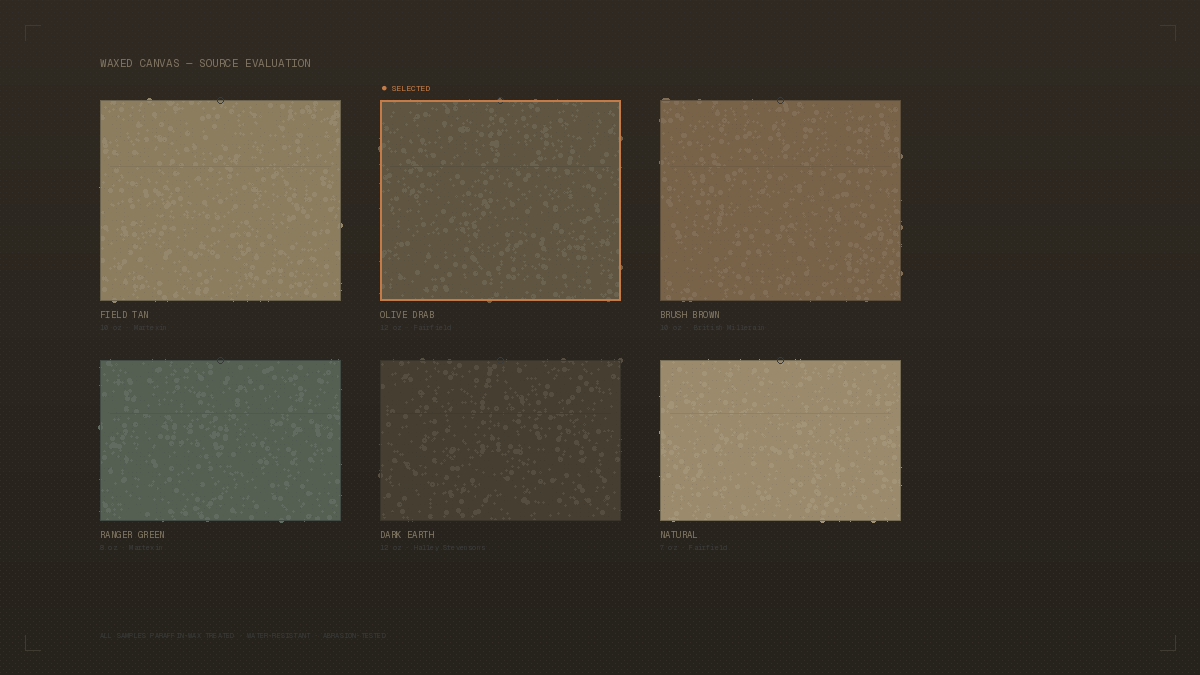
The waxed canvas cover on the NS-K01 needed to be 12oz waxed duck cloth. Not cotton twill (too light), not synthetic (doesn't age well), not nylon imitation (holds water). Duck cloth—actual duck weave—with a beeswax and paraffin finish that sheds moisture, develops character over time, and actually gets better with use. That's the spec. Finding someone who makes it domestically, at the quality we needed, within a lead time that doesn't add eight months to production, took three months of sourcing work.
Why domestic supply matters
The standard model says: overseas mills can produce at 30% lower cost. Asian suppliers have massive capacity. They can handle large minimum orders. The pitch is always the same—economies of scale, established infrastructure, proven supply chains. All true. Except when it comes to specialized fabrics that require quality control, when you need to iterate on finish, when you're building a product that reflects specific values.
Domestic manufacturing means three things: lead time, QC accountability, and the ability to have a conversation. With an overseas mill, you send specs, you wait 14 weeks, samples arrive, and you discover the weave density is slightly different than expected. You either accept it or re-order. There's not a relationship; there's a transaction. With a domestic supplier, you can say "the wax saturation is uneven on this edge; let's adjust the bath timing," and the conversation happens over coffee, not through email at misaligned time zones.
The cost premium is real. Domestic production at smaller scale is 40% higher per yard than what a large Asian supplier would quote. For a venture-stage company building a premium product, that's a decision: are you competing on price, or are you building something that reflects values? We decided the 12oz waxed duck cloth, sourced domestically, with QC you can actually talk to, is part of the product story. Not an afterthought. Not a commodity input. Part of the thing itself.
The specification journey
I spent weeks with test samples understanding what we actually needed. The NS-K01's cover needs to shed water without absorbing it (so the wax saturation can't be light). It needs to fold without cracking (so the base cloth needs structural integrity and the wax needs plasticity). It needs to age gracefully (so natural fibers only, with a finish that mellows rather than degrades). And it needs to be dark enough that it's visually unobtrusive when deployed—earth tones rather than bright white.
The weight specification was non-negotiable. 12oz duck cloth means the raw woven fabric weighs 12 ounces per square yard. Lighter—say 10oz—and you lose the stiffness required to hold the fold geometry. Heavier, and you're adding weight to a product where every pound matters for backcountry transport. 12oz is the mathematical center of the range.
Wax saturation turned out to be the hardest variable. Too light, and the fabric absorbs water through the exposed fibers. Too heavy, and the cloth becomes brittle in cold—which is exactly when you need it to remain flexible. After testing fifteen samples from various mills and suppliers, the sweet spot was a finish that came in right at 55-60% wax content by weight. That's high enough to shed water but low enough that the underlying cotton properties still function.
Edge behavior was something I obsessed over. When you cut canvas, the cut edge shows bare fibers. On a waxed surface, those edges need to be finished—either heat-sealed or sealed with additional wax—or they become water-infiltration points. I tested canvas edges after soaking in field conditions and discovered that some finishing methods left an obvious built-up line, while others absorbed wax and disappeared into the surface. We specified a specific edge-sealing approach that adds to the production cost but ensures edge durability.
Finding a North Carolina mill
There are maybe four active mills in North America still producing 12oz cotton duck. Most have moved to synthetic alternatives or lighter weights. I contacted all of them. Two never responded. One quoted a 22-week lead time and minimum order of 5,000 yards. The fourth was Warren Textile Mills in North Carolina, a family operation that's been making heavy cotton duck for industrial applications since 1987.
Warren understood what I was asking because they'd done it before—canvas for heritage camping brands, for institutional applications, for people who'd worn out the gear from the 1970s and wanted new fabric that matched the original specification. They had documentation on wax saturation from the pre-synthetic era. They knew how to seal edges. They were interested in a new customer building a premium product.
The first conversation was on the phone. I explained the application, the volume we were expecting (2,000-4,000 yards annually, scaling with production), the quality requirements, the timeline. They said, "Come down and let's weave a test batch." That's how you know you're talking to the right supplier. Not "we'll quote you a price," but "let's make something together and see if it's right."
What the relationship looks like
We've done three test batches now. Each one has been slightly different—adjusting the base weave density, the wax composition, the edge-finishing process. Warren has been deliberate about understanding how we use the fabric. One of their production managers asked if the cover experiences significant wind loading. I said yes, at altitude, where the ultraviolet exposure is intense. They asked what temperature range we operate in. That level of specificity informed their recommendations.
The production process for our specification takes roughly 8-10 weeks. Raw cotton comes in, gets woven to our weight spec, gets the wax bath treatment, gets edge-sealed, gets inspected, and ships to us. We can place orders with two weeks' notice and receive fabric within two months. That's not instantaneous, but it's manageable for production planning. And we have the ability to place small orders (500 yards) without breaking their production flow, which matters in a venture-stage business where you're scaling unpredictably.
The pricing is not at commodity scale. We're paying roughly $8.50 per yard for the finished fabric. An overseas alternative would be $5.80 per yard. For a 48-inch by 96-inch cover, that's about $32 in material cost difference on a $1,200+ field kitchen. That's less than 3% of the final product cost. For that investment, we're getting domestic supply, QC we can talk to, and a material that reflects actual values.
Why cheaper wasn't the answer
We did explore overseas options. The pitch was compelling: $5 per yard, same weight specification, 40,000-yard minimum order. At that scale, the math works. Except we don't know the supply chain quality, the wax composition, the edge-sealing process, or whether the specification will remain consistent after year one. And if there's an issue—if the wax saturation drifts, if edge failure shows up in the field—you're six weeks from a conversation, not six days.
For a product that lives in backcountry environments, that doesn't make sense. The waxed canvas isn't a component; it's a statement. It says this brand understands material durability and aging. That only works if the actual material performs as promised, consistently, and if there's accountability behind it.
The aging story
Here's what makes the sourcing decision matter over time: waxed canvas, properly made, actually improves with age. The wax mellows. The patina deepens. The weave settles slightly and becomes more water-repellent. After two seasons of use, a 12oz waxed duck cover should look better and perform better than it did brand new. That's not marketing copy; that's material science. It requires the right base cloth, the right wax composition, and the right finish process. Warren Textile Mills knows how to do that. The overseas alternative would have cut quality corners we wouldn't discover until year two.
Building a premium product means making those decisions at every level. Not just the aluminum alloy or the oak handles, but the canvas that wraps it all together. That's why we said no to cheaper, faster, bigger. We said yes to a relationship with a textile mill in North Carolina that cares about material as much as we do.